Google's New Free Font Covers More Than 800 Languages — post content
2026 Update. This article was published in 2017; as of May 2026, context has been added based on current practices in the Turkey digital marketing and web technologies industry. The information below consists of practical recommendations under the Technology Agenda category that remain valid in 2026.
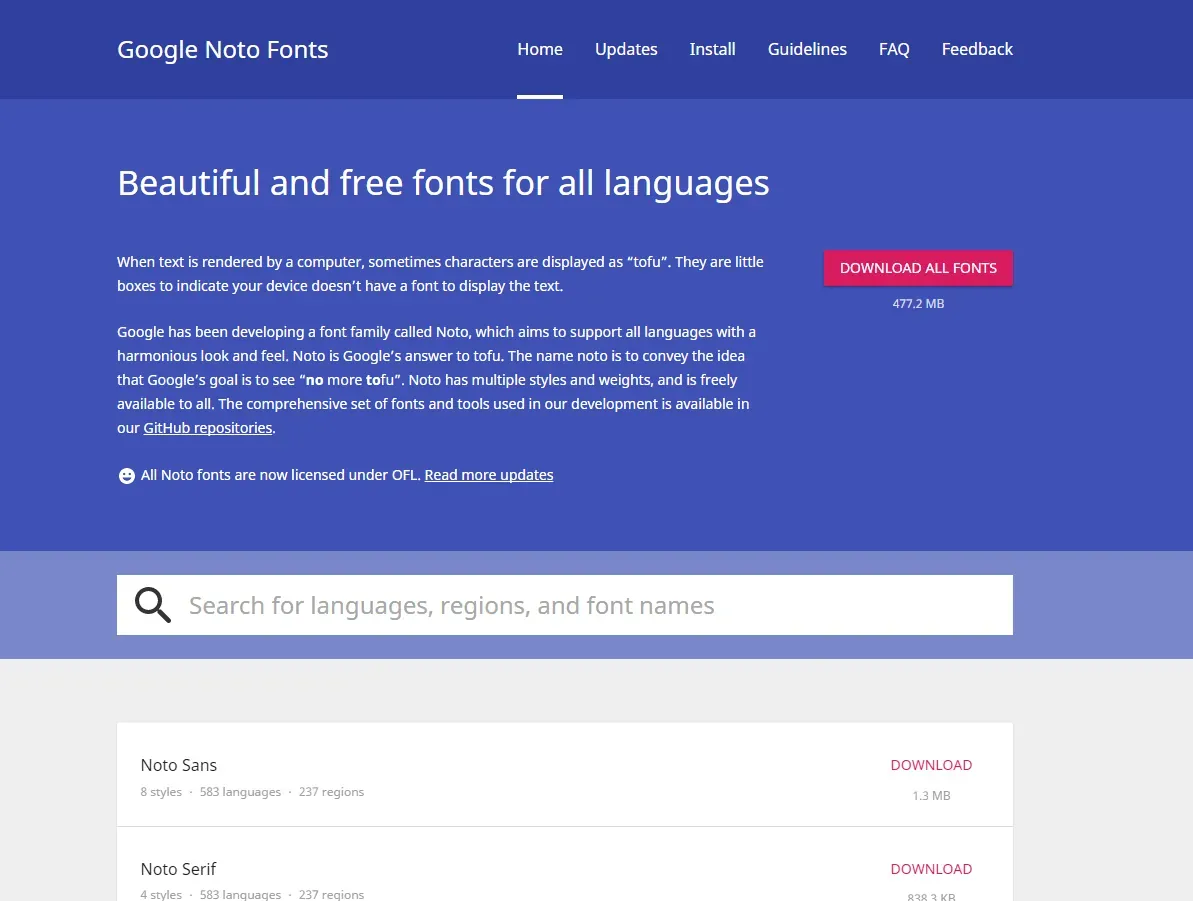
Google has created Noto, a vast open-source font family covering more than 800 languages and 110,000 characters, to make it easier for people from all over the world to create and share information in the language they choose. This Font covers every symbol in today's Unicode standard. Google's project to make Android and ChromeOS more accessible took five years to complete and saw the participation of typography and font design experts from Monotype and Adobe.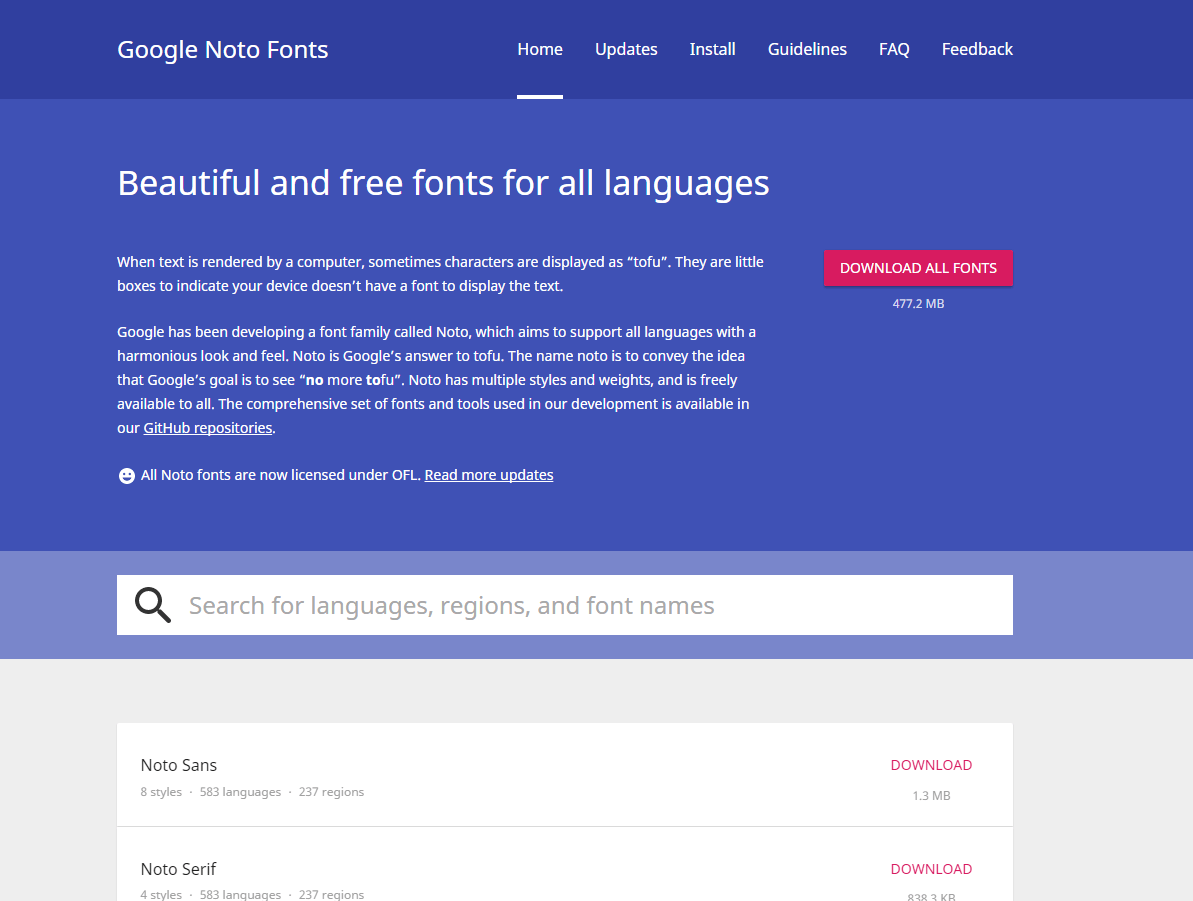 The name Noto comes from the phrase 'No more tofu', referring to the rescue of empty characters ('⯐', also known as tofu) from the Web that are displayed when the required symbol from a particular language is not available on the user's system. Noto offers an elegant, unified appearance across languages and is free for any kind of project.
The entire font family, along with its weights and styles, comes in at a weight of 472 MB (the largest packages include Traditional Chinese, Simplified Chinese, and Korean characters). You can grab them all at once or just choose the ones you need; if you only want Turkish, you can search in the search box and grab the first three small packages.
Google has also recently prepared these through the renewed excellent Web Fonts site. Additionally, you can download Noto's open-source and design-source files from this GitHub repository. The company also says it is committed to keeping Noto up to date and that it will continuously be added to as Unicode evolves to support more languages and characters.
The name Noto comes from the phrase 'No more tofu', referring to the rescue of empty characters ('⯐', also known as tofu) from the Web that are displayed when the required symbol from a particular language is not available on the user's system. Noto offers an elegant, unified appearance across languages and is free for any kind of project.
The entire font family, along with its weights and styles, comes in at a weight of 472 MB (the largest packages include Traditional Chinese, Simplified Chinese, and Korean characters). You can grab them all at once or just choose the ones you need; if you only want Turkish, you can search in the search box and grab the first three small packages.
Google has also recently prepared these through the renewed excellent Web Fonts site. Additionally, you can download Noto's open-source and design-source files from this GitHub repository. The company also says it is committed to keeping Noto up to date and that it will continuously be added to as Unicode evolves to support more languages and characters.
Why this topic matters in 2026
The technology agenda field in Turkey went through three fundamental shifts between 2024 and 2026: (1) mobile-first user behavior reached 78% of the market, (2) AI-powered content production and analysis tools entered the mainstream, (3) with KVKK, e-Commerce 2.0 and Turkish Lira improvements, the cost/impact balance of digital presence for small-to-medium-sized businesses fundamentally changed. The principles described in this article still apply at the implementation level under 2026 conditions — only the tools and service providers used have been updated.
Quick checklist for 2026
- Mobile-first: Test the design and content architecture first on a screen width of 390-430px; desktop is secondary.
- Performance budget: LCP < 2.0s, CLS < 0.05, INP < 150ms — Core Web Vitals 2026 thresholds have tightened.
- AI integration: Embed Claude/GPT-4 class assistants for content production, image optimization, and customer support; not a one-off prompt, but a flow.
- Legal compliance: KVKK disclosure text, cookie consent (TCF v2.2), email opt-in must be double opt-in (DOI).
- Measurement: The trio of GA4 + Meta Conversion API + server-side tracking has become standard; GA4 alone is insufficient.
- Branding: Rather than a single logo, dynamic brand systems (color, typography, motion) are coming to the fore on social channels.
Next step
To apply the topic of this article in your own project, you can request a free site analysis, directly send a brief, or request a one-on-one meeting. I return all evaluations within 2 business days, in a KVKK-compliant manner.
The article was first published on 11 Jan 2017, and revised according to 2026 conditions as of 03 May 2026.
Where is Turkey's technology agenda heading in 2026?
Turkey's technology ecosystem transformed along three axes between 2024 and 2026: (a) AI-powered production tools (Claude, GPT-4, Gemini, domestic LLM trials) entered the daily workflow for both software developers and content creators. (b) Thanks to mobile payment and open banking, e-commerce entry barriers for SMEs dropped by 60%. (c) KVKK secondary legislation, cookie consent, and data residency rules brought investments under strict scrutiny. This trio has recontextualized the classic web/software topics we cover in our blog posts: the tools have changed, the principles remain.
Looking at the sectoral distribution, the software stacks actively used in Turkey as of 2026 are as follows: WordPress still leads the SME web market with 43%; the Next.js / Astro / Svelte trio is dominant on the corporate+SaaS side; on mobile, Flutter and React Native usage has reached 71%. On the social media side, the trio of Instagram + WhatsApp Business + TikTok absorbs 78% of advertising budgets. LinkedIn maintained its weight in the B2B segment, while X (Twitter) maintained its weight in the publishing + media segment.
DijiPal® 2026 approach
With my 16 years of advertising agency experience, I learned every topic I share on the blog by applying it to my own client projects. As of 2026, our approach as DijiPal® is based on these three principles:
- Transparency. From brief to delivery, every stage is visible via weekly staging URLs. No surprises.
- Mobile-first + AI hybrid production. Design and content are validated on a 390-430px screen; during production, Claude / Midjourney / Cursor IDE works integrated into the workflow — AI provides the speed, the human makes the decision.
- Measurable results. With every delivery, GA4 + Meta CAPI + server-side tracking are integrated; evaluation is done with conversion-first metrics.
If the topic of this article is turning into a concrete need for you, share your brief — I will get back to you within 2 business days with a sector-specific roadmap and a transparent quote.
Next step
Do you have an existing site? Request a free site analysis — we will send the gaps and recommendations to your email within 2 business days.
Are you starting a new project? Send a brief, get a response with a sector-specific package and price within 2 business days.
To find sector notes, you can review the 21 sector guides or this blog's archive of 330+ articles.


